

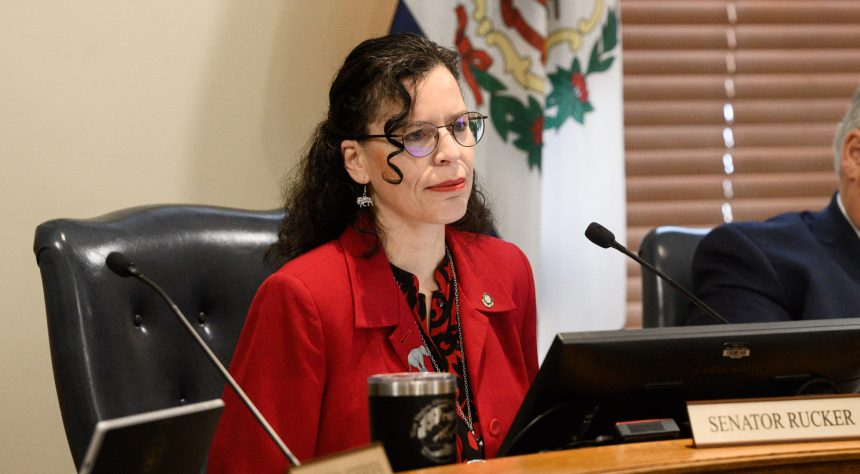
CHARLESTON — A renewed debate over who should be allowed to vote in West Virginia Republican primaries drew sharp criticism this week from state Sen. Patricia Rucker, who said opponents of closed primaries are attempting to undermine party control of its own nominations.
Rucker (R-Jefferson, 16) told The Shepherdstown Register that the issue has resurfaced repeatedly despite a 2024 vote by the West Virginia Republican State Executive Committee to close GOP primaries, allowing access to only registered Republicans.
“Like the mythical hydra which sprouted two heads for every one that was cut off, the issue of the Republican Primaries in West Virginia refuses to be laid to rest and the opponents keep coming back to the same old arguments,” Rucker said.
Rucker’s comments come after a Mountaineer Journal report that a small circle of West Virginia Republicans are working behind the scenes to revive open GOP primaries, despite a 2024 decision by state party leaders to restrict participation to registered Republicans. According to sources with knowledge of the discussions, organizers are positioning the issue for consideration at the next state party meeting, scheduled for Saturday, Jan. 10, 2026, at 1 p.m. at the Four Points by Sheraton Hotel in Charleston, prompting concerns that a settled matter is being fast-tracked for reversal with limited public visibility.
Rucker accused supporters of open primaries of benefiting from allowing Democrats registered as independents or unaffiliated voters to participate in Republican primaries. She said those voters often seek to influence GOP races by supporting weaker or more moderate candidates.
“The Democrats in West Virginia know that they have almost no chance in actually beating the Republican candidate if one is running, so they benefit from ensuring the weakest-ideological Republican or the most liberal Republican gets through the primary,” Rucker said.
She also argued that Republican candidates who benefit from those crossover votes have an incentive to keep the current system in place.
“These ideologically-weak or liberal Republicans benefit from these votes so they will stop at nothing to keep the primaries open,” Rucker said.
The West Virginia Republican Party’s state committee voted last year to require voters to be registered Republicans to participate in GOP primaries, a change scheduled to take effect beginning with the 2026 election cycle. Before, unaffiliated voters were allowed to choose a Republican ballot.
Rucker said last year’s vote reflected the will of the party’s grassroots members.
“But Republicans in WV have spoken,” she said. “The elected members of the WV GOP State Committee voted to close the primary because they have heard from their membership — the real Republicans who care about the party and about principle.”
She emphasized that primaries exist to determine party leadership and nominees, not to serve as general elections.
“The purpose of the primary is to elect the leadership of the party and only registered Republicans should be making that decision,” Rucker said.
While noting she has no objection to how Democrats conduct their own primaries, Rucker said Republicans must retain control over their party’s direction.
“I don’t care what the Democrats choose to do with their primary or their party, but I do deeply care that Republicans control their own party leadership,” she said.
Rucker warned that allowing candidates — who do not reflect the party platform — to advance can have broader consequences.
“When we fail to elect those who represent the party platform and principles, we lose voters and support for all Republicans,” she said.
The comments come as some county-level party leaders continue to push for reopening Republican primaries, setting the stage for an ongoing internal debate ahead of the 2026 elections.